
| |
 |
British Foreign Policy 1815-65 |
I am happy that you are using this web site and hope that you found it useful. Unfortunately, the cost of making this material freely available is increasing, so if you have found the site useful and would like to contribute towards its continuation, I would greatly appreciate it. Click the button to go to Paypal and make a donation.
This information is taken from the American Civil War Field Fortifications Website and is reproduced here with the kind permission of the webmaster to whom thanks are due. Copyright, of course, remains with P. E. McDuffie. This document has been taken from its primary location on The Victorian Web.
Literally translated from the French, the phrase means 'Frisian horses'. In this context it refers to obstacles erected as a means of defence.
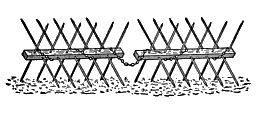 Chevaux-de-frise
were useful for the obstruction of roads and intervals between field works where
it was undesirable to construct more permanent and unmovable types of obstructions.
They could also be used where the ground was either too hard or too soft to
erect palisadings or stockades. Chevaux-de-frise could stop cavalry dead in
its tracks, but really were not a serious obstacle to the passage of infantry.
Because chevaux-de-frise were time consuming to construct and required special
tools and some carpentry skill to bore the holes for the cross stakes (called
lances) they were generally only used where armies had plenty of time and labor
available to develop their field works. Like all wooden field works they could
be shattered by artillery very quickly.
Chevaux-de-frise
were useful for the obstruction of roads and intervals between field works where
it was undesirable to construct more permanent and unmovable types of obstructions.
They could also be used where the ground was either too hard or too soft to
erect palisadings or stockades. Chevaux-de-frise could stop cavalry dead in
its tracks, but really were not a serious obstacle to the passage of infantry.
Because chevaux-de-frise were time consuming to construct and required special
tools and some carpentry skill to bore the holes for the cross stakes (called
lances) they were generally only used where armies had plenty of time and labor
available to develop their field works. Like all wooden field works they could
be shattered by artillery very quickly.
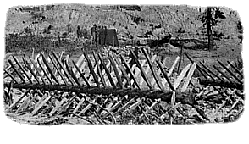 Chevaux-de-frise
on Marietta Street, Atlanta, Georgia, USA
Chevaux-de-frise
on Marietta Street, Atlanta, Georgia, USA
| Meet the web creator | These materials may be freely used for
non-commercial purposes in accordance with applicable statutory allowances
and distribution to students. |
Last modified
12 January, 2016
|